Showing posts with label Religious Education. Show all posts

Friday, November 26, 2010

So, you are getting married. Congratulations, and get yourself a prenuptial.

While marriage has been talked about very positively in the Quran, divorce has not only been permitted, but its technical and legal aspects have been discussed in more details than marriage itself, and that makes sense: it is a conflict situation, and that deserved more elaboration. 
But divorce has been look down upon in most Muslim communities - though not by Islam as a religion - as an irresponsible act showing a weak character that prefers personal convenience over the hard work needed to establish a healthy family.
That negative attitude towards divorce unnecessarily deprived many Muslims of a legitimate, and frequently needed, social procedure. Divorce rates thus have been exceptionally low (as low as 2-3%) in the Muslim world for centuries, reflecting the social pressure against divorce rather than how happy marriages are.
But that low divorce rate is changing rapidly. American Muslim divorce rates are very close if not actually equal to divorce rates among non-Muslims. That increase by 10-15 fold in the span of one generation has its own problems.
Divorce was discussed and organized in the Quran 1500 years ago not as an evil thing, but rather as an occasional social necessity.  It was thus to be discussed and regulated. But the focus in the Quran was on:
a) preventing hasty and abusive actions the husband,
b) explicitly mandating mediation and counselling before divorce is finalized,
c) establishing the children's financial rights,
d) providing some security to women against instantaneous eviction from the family residence at a time when husbands were exclusively responsible for providing family residence,
e) the Quran also established the right of women to divorce themselves at will using a clear and simple procedure known as khol'a, a definite revolutionary social concept that most Muslims are not even aware of.
The Quran, however has not provided any rules for asset sharing, or guidelines for financial settlement between spouses.  The contemporary rules were that the wife, as much as the husband, was entitled to trade, to buy and sell, and to have full financial control over her own wealth, inheritance and business.  When divorced, each spouse kept their own property and assets. Also, issues like children custody, alimony, etc, were not discussed much and the prevalent common law was followed.  
Over 2-3 centuries after the Prophet's death more 'common law rules' (or 'عرف'  in Arabic), that did not contradict obvious Quranic principles, crept into Islamic law, which by that time became known as shari'a.  These new laws and rules reflected mostly the common law of those times as understood by different scholars, almost exclusively men.  Those also were the times women's rights took a significant step backward, from the earlier and enlightened phase of Islamic thought process at the time of the Prophet and early civic leaders after him.
At this point it is important to highlight that while common law has frequently been adopted by Islamic legal system, it should never be considered integral to the religion of Islam. Islamic religious rules (Quranic and 'mutawater' Prophetic teachings) are immutable, while common law accepted by different societies in different eras should be freely changed if the circumstance under which they were accepted change.
Over the last century, most of the Muslim countries amended their Family Law to include more rights for women that were not traditionally included in early jurisprudence, such as alimony and mother-favoring custody of children, in some cases granting near exclusive rights to the mothers.  In Egypt, for example, mothers have full custody over boys until age 16, and over the daughters until they reach the age of majority or get married.
These modern changes in family law illustrate that those laws are mostly of civic nature, not a religious one.  Despite these facts, many first generation American-Muslims think of those laws as 'Islamic laws'.  And that is where the problems is.
Having been involved at different levels in many divorce cases among friends over the last few years, I have made several observations.  The most alarming of which is that most of the individuals in those cases have no clue what is mentioned in the Quran about divorce.  That is a shameful thing truly as it all can be contained in 3-4 medium size pages. 
In many of those divorce cases, an argument was frequently made that ' … as Muslims, we are obliged to follow Islamic law when it comes to divorce'.  Advocates of that opinion usually refer - unknowingly - to the 'civic' law that ruled over them or over their parents when they lived in the old motherland.  Many of those laws were not mentioned in the Quran, and are not necessarily followed by any other Muslim country, since each country had it own set of unique family laws. Therefore, those old homeland rules are NOT Islamic.
Another common observation was that the apparently 'wise and pious' suggestion to follow Islamic law was usually made by the party that was most likely to lose financially if the 'American law' is applied.  In other words, advocating the so-called Islamic law for divorce was frequently a gimmick to keep as much money as possible in the hands of the wealthier spouse, be it the husband or the wife.
But considering the high cost of the legal system in the US, the demand (or suggestion) to follow Islamic law does seem to have merits, if it were not for ignorance and possibly the ill-intentions that were behind it.  
And to complicate matters more, there is usually some social pressure within the community to follow 'Islamic law' even though most people do not know what that precisely meant.  If one spouse preferred follow American divorce and family laws they were sometimes made to feel as if they were rejecting of Islam.
My advice for whoever asked for my opinion was always the same: "Get a good lawyer, never negotiated without your lawyer being informed of what you are doing, and avoid court if you can, but do not yield under the assumption that it is 'Haram' or 'Islamically unethical' to settle your divorce in court."
As more women and men of our Muslim-American community get divorced, we need better ways  to educate ourselves regarding the rules of divorce in Islam and the many aspects it does not handle.  We also need to know that marriage in Islam is a contract – a real contract, in which ANY condition can be stipulated.  The spectrum of those stipulations can surprise most of us: from granting women right to divorce on demand, to financial and custody stipulations and all the way to stipulating, that the family must have hired help, nannies, cooks, or in which city to live, etc.
I would like marriage within the Muslim community to take full advantage of the flexibility of Islamic marriage contract by discussing some issues that can save the families a lot of trouble in the future, when one out of every two or three marriages ends in divorce.  The most important item should be: which legal system the couple should follow if divorce process is initiated.  And if they choose 'Islamic law' they need to spell out what that means.  And if they have no clear idea what Islamic law of divorce means, then they should explicitly state the American legal system would be the reference, so it does not as a surprise to any spouse if that ends up being the case.
It is difficult for a couple busy planning their wedding party to consider prenuptial. And that is understandable.  But if our community is wise, it should try to minimize or avoid the acrimony that comes with hostile divorces, and avoid the drainage of resources wasted on lawyers that could otherwise go to secure better future for the divorcees and their children.
Our community is still young in this country.  Many individuals are in the middle of an identity transition, from a Syrian-Muslim, Pakistani-Muslim, Bosnian-Muslim or some other 'hyphenated Muslim' to American-Muslim.  Most of us have not put much thought into what these terms mean. 
That is where most of the friction comes from: unclear terms, and an identity-in-transition.
In my opinion, it could be a great service to our community if the marriage certificates issued by Islamic institutions in the US for American Muslim couples getting married is expanded from the simple contract it is now, to a more developed format that offers a collection of simple choices that may save many couples a lot of heartache and money in the future. That 'expanded' marriage contract could function as a 'default' prenuptial agreement that provides the couple with some idea how things could be handled when married life does hits some road bumps.
If you were to have a prenuptial agreement, as an American Muslim, what would you want to see in it?

Khaled

Saturday, May 2, 2009

Custom-made Religion and 'Child Brides': What is Prophetic tradition (Sunna) and what is not?

Last month the saga of the Saudi father ('father' used here in a very loose sense) who married his 8 year old daughter to one of his acquaintances as a 'dept-repayment' was on the Arabic and international media. The mother, who opposed the marriage filed to annul the marriage before a local court but her request was denied and the 'legality' of the transaction was upheld. The judge said he tried to convince the husband to divorce the girl, but the husband refused.

The outrage in Arabic and international circles led the prince of Qaseem, the province in which the shameful transaction has taken place, to intervene by assigning a new judge to the case. But rather than make a judgment on the illegality of such marriage, the judge conducted intense negotiations leading to out-of-court settlement that involved financial compensation for the husband. Not surprisingly, the father will not face any penalty (You can find details here and here).

Such idiocy in Qaseem, a province considered to be the heartland of Saudi Islamic fundamentalism, is protected under Saudi law. Actually, Saudi legal system does not have a problem with an 8 year old girl marrying a 50 year old man as a payment for her daddy's dept. That same legal system is not troubled either by marrying 9 year old boys. For them Islam said it is OK to do that. Regulating that is, for many, un-Islamic.

According to newspapers, the senior clerics of Saudi Shura Council may consider setting a minimum age for marriage - a revolutionary concept by Saudi legal standards. Unfortunately that is by no means certain. And moreover, it will require re-programming segments of the population to un-think that marrying little girls (or boys) is the normal Islamic practice (for example see here for an interesting discussion - Sorry, but that article is in Arabic only).

My concern with weird behaviors like those practiced in Saudi society (for example child brides, not allowing elections, and banning women from driving) is that behavior of Saudi society tends to masquerade as the proper Islamic practice. Sadly, Saudi 'norms' make it very difficult for level-headed Muslims to fight such anomalous practices in other Muslim societies. The Saudi kingdom has, geographically peaking, the Islamic Holy places. But that does not make the social norm of Saudi society Holy.

Custom-made Islam - specifically tailored to suit the desires of whoever is in power in many backward Muslim societies - is a common practice. In the name of Islam we see things that range from closing girl schools in Afghanistan and attacking Shia in Pakistan to atrocities against civilians and foreigners in Algeria.

Custom-made Islam is used to support independence in southern Philippines yet to resist independence or separation movements in southern Yemen. It is used to revolt against American forces in Iraq but to promote acceptance of their presence in Saudi Arabia and other Gulf states. It is used to topple Pakistani government, while making people submit obediently to Saudi and other oppressive Arab governments.

Part of the problem is the greed for control and power that is made easy using a religious facade in traditionally religious societies (see my previous posting on Alternative Islam, for example), but that is not the whole problem. Frequently it is the desire to 'find religion' in practices that are not of religious nature. Age of marriage seems to be one of those situations.

The root of the problem of marriage age usually goes back to the little we know in Islamic history about how young Aisha, the Prophet's wife, was when the Prophet married her. I will not get into the details and the controversies about it because, truly, it is irrelevant to my discussion of the issue.

What is relevant is how practices by Prophet Muhammad, peace be upon him, were considered a prophetic tradition or Sunna (i.e., Prophet's acts to be adopted as part of the religion). Age of marriage was never an issue in the Quran. There was no hints to it, no allusions to it, nothing about it - nothing at all.

And regardless of what the Prophet did (which is not even established with certainty) when he married Aisha, it was not anything that raised the ire of people around him, people who endangered their lives and social status by following him, and who believed in him as a result of what they have known about him as a role model and an example for morality.

That is to say, whatever he did by marrying Aisha was seen as normal and followed a contemporary societal norm and was not viewed as a violation of that norm. And just because the Prophet followed prevalent social norms, that alone does not make them Religion.

He used camels and horses for transportation. He did not sleep on beds, and he did eat the prevalent foods (except what was clearly prohibited in the Quran such as pork and alcohol) . He socialized with his companions in the way that was befitting a decent civilized person by their standards. There was no running water in his time and no indoor pluming in his hime. And as for bathrooms; bathrooms were in the open outdoors. He was not opposed to the medical practices of his time, nor to the lack of organized school system.

He delivered the message he received from God and he prohibited the practices that appeared to contradict God's message. Then, he accepted the rest of life - in my mind without making a religious ruling about it. He was explicit about what God wants, and equally explicit delivering God's prohibitions and we should follow those. As for the rest of worldly life tools and norms, it is up to us to decide what suits our times, as long as we are not obvious violating the message of Islam.

Many Muslim societies have moved on and regulated marriage and other aspects of social life. Most of those societies do not claim that their choices for societal rules represent Islam. And that is good for Muslims and, above all, is good for Islam. The worst religion is that which casts people's own desires as God's commandments.
أَفَرَأَيْتَ مَنِ اتَّخَذَ إِلَهَهُ هَوَاهُ وَأَضَلَّهُ اللَّهُ عَلَى عِلْمٍ وَخَتَمَ عَلَى سَمْعِهِ وَقَلْبِهِ وَجَعَلَ عَلَى بَصَرِهِ غِشَاوَةً فَمَن يَهْدِيهِ مِن بَعْدِ اللَّهِ أَفَلَا تَذَكَّرُونَ

"Hast thou ever considered [the kind of man] who makes his own desires his deity, and whom God has [thereupon] let go astray, knowing [that his mind is closed to all guidance] ...?" (Quran, chapter 45:23)
Very few of today's Muslims would forgo indoor pluming, traveling by plane or sleeping on beds as a way to follow the Prophet's foot steps. I can attribute not following the prophet on those issues to the belief that when the Prophet washed, traveled and slept in a different way, he was not legislating religion. Rather, he was adopting an acceptable social norm that did not violate Islam as he knew it.

Why then do hyper-religious Muslims think that wearing a particular kind of clothes, using fingers to eat, or a particular aroma of perfume is a religious matter (Sunna) while those same people sleep in beds, travel by plane, drive fancy cars and have marble-floored indoor bathrooms; while the prophet pbuh choose different way to sleep, to travel, and to use the bathroom?

And why would their even be fear of violating Islamic rules by setting an age limit to marriage in Saudi Arabia on in other fundamentalist Muslim circles?

I am not naive to think that deciding on marriage age limits is the biggest problem facing Islam today. But I think that the way we approach a solution to that issue as well as other 'fake' religious issues is a reflection of where the soul of Islamic thinking is heading. And that should be an issue of grave concern to all Muslims today.

Khaled

Monday, April 28, 2008

Do not insult Allah; He is your God too.

04/28/2008 6:38 pm
The icon of evangelical fundamentalist Christianity, Pat Robertson, would not waste a chance to restate that Muslims do not worship the same God that ‘Judeo-Christian’ believer’s do. I am not sure if most Jews agree with his Christian understanding of God, but that has never stopped him and others of the same mindset from making that claim.
To him, Allah is not God. It is just an Arab Muslim Idol. Not only that, but he comes up with whole Hollywood type story about the moon god who has three daughters that Muslims worship (see that and more equally ‘smart’ statements here http://www.cbn.com/700club/features/bringiton/falsereligions-index.aspx#3. This nonsense is ear-catching for his target audience, but is just - to put it mildly - stupid; plain and simple.
These statements prove that one may be famous, rich, and influential yet be totally ignorant and do not even know what they are talking about. That, unfortunately does not change the fact that many non-Muslims, especially in North America, that still think the same way, regardless of what they think of Pat Robertson.
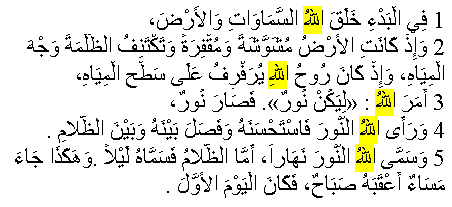
Allah is the Arabic word for God (upper case ‘G’). It has its roots in Aramaic, one of the roots of Arabic Language, and has been used many centuries before Islam by Arab Jews and Christians. Not only that, it is the word used for God/Lord (upper case) in the Arabic translations of the Old and New Testament.
Take a look at this example from Genesis (http://www.ibs.org/) with the Arabic translation from http://www.biblegateway.com/. The words “God” and “Allah in Arabic, الله ” are highlighted:
1 In the beginning God created the heavens and the earth. 2 Now the earth was formless and empty, darkness was over the surface of the deep, and the Spirit of God was hovering over the waters.
3 And God said, “Let there be light,” and there was light. 4 God saw that the light was good, and he separated the light from the darkness. 5 God called the light “day,” and the darkness he called “night.” And there was evening, and there was morning-the first.

And for an example from the Gospel of John:
1 In the beginning was the Word, and the Word was with God, and the Word was God.
2 The same was in the beginning with God.

Arab Christians use the word “Allah” (meaning God) in their prayers and worship. Many Arab Christians have the name “Abd-Allah”, meaning the “Servant-of-God”, the same name that many Muslims have. The image on the side is the Arabic script for ‘God is Love’, a common saying for Egyptian Christians. Notice the word on the right. It is Allah (for God).
The Arabic language has masculine and feminine forms. Like English, it also has single and plural forms, with a third form for a count of 2 of the same thing. The word Allah in Arabic has a very special status though. It is not defined as masculine or feminine, it exists only in the singular form, and it does not undergo any derivation. Grammatically it is treated as masculine, but it has no inherent gender.
The uniqueness of the word Allah in Arabic may be in part responsible for the occasional use of Allah by Muslims speaking in English, rather than the word God. The word god has multiple forms: upper case, lower case, plural and feminine forms (God, god, gods and goddess). It can be used to describe the absolute divine, but it can be used to describe a teen idol or a music diva. I personally prefer to use the word ‘God’, but I would always remind my listeners that it is the ‘upper case one’.
I know some people may be now thinking: Well, even if it means God it still does not mean that Muslims worship the same God Christians and Jews worship. So here is a brief primer on divinity in Islam.
Islam is a monotheistic religion (defined by some as ‘rigidly’ monotheistic). God in Islam has no form or shape that is amenable to human senses, but his presence can be perceived. Therefore, humans can sense the existence of the Divine, and believe in it. Any attribute of His that may have a human equivalent, is made with no attempt to make analogy or simile to humans.
This is expressed in a very short chapter of the Quran (Ch. 112, 1-4): “SAY: He is the One God: God the Eternal, the Uncaused, Cause of All Being. He begets not, and neither is He begotten; and there is nothing that could be compared with Him”.
In Islam, God is the ultimate abstract idea of a Divine Entity. He has no beginning, and no end. He is the creator of the universe and the sustainer of all that exists. He is the Master of the Day of Judgment. He cares about us, knows what we do, and wants us to succeed in this life, and in the life after.
If someone does not think that this is the God they worship, then that is their concern. As for those who grasped my description of what God means to Muslims, the next time one feels like saying something nasty about “Allah”, they should hold back. It is their God too.